

 ingfakrapee/123RF
1980s vs. 2025:
How up to date is European occupational safety?
ed* No. 02/2025 – Chapter 1
When the European Framework Directive on occupational safety1 was adopted in 1989, the world of work was different. Industrial jobs dominated, computers were rarely found on desks, and psychological stress was at best a marginal issue. Occupational safety at that time was mainly intended to reduce physical risks. In the sense of securing machinery, providing protective clothing, and reducing accident numbers. The introduction of the Framework Directive and the individual directives based on it was nevertheless a milestone, because they established principles such as the right to safe and healthy working conditions throughout Europe.
More than 35 years later, the reality of the labour market has fundamentally changed. Digital technologies, artificial intelligence (AI), hybrid and new work models, as well as the blurring of working time and place, create new demands on workplace safety and health protection. Hazards today are more complex. They are often invisible and escape classic control mechanisms.
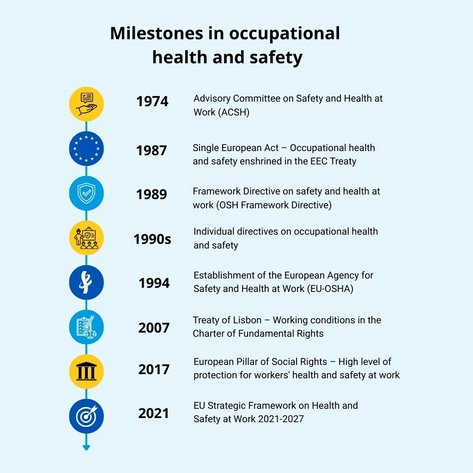

In the ongoing revision of EU health and safety pieces of legislation, it is vital that social partners work together through genuine and inclusive social dialogue, building on the EU Strategic Framework to ensure that updated rules respond to the realities of today’s labour market. A future-proof EU acquis must anticipate the challenges of digitalisation, climate-related risks, demographic change and cross-border mobility, while strengthening prevention, inspection and enforcement mechanisms. This means extending protection beyond traditional employment relationships so that non-standard workers such as platform, domestic, seasonal ones as well as migrants are fully covered. Only by co-designing legislation with employers’ and workers’ organisations can we create legislation that leaves no one behind in the transition towards a safer, fairer and more sustainable world of work.
At the same time, many of the principles from that period remain valid. The obligation to carry out risk assessments, prevention, and worker participation still forms the backbone of the protection system. But are these instruments sufficient to effectively protect the European world of work today and in the future?
It is becoming increasingly clear that the issue is not only new laws but also a new interpretation of existing rules. Those who take psychological stress seriously must record it just as systematically as noise emissions or hazardous substances. Those who use digital tools in occupational safety must involve employees and ensure data protection. Those who discuss the occupational safety of the future should also consider the working realities of platform workers, caregiving family members, older employees, or workers who work across borders.
In today’s political climate, this is more important than ever. Occupational safety is a key prerequisite for a strong and resilient European economy. Healthy employees work more sustainably, more innovatively, and more productively. Europe’s economic strength depends on maintaining and continuously developing the high occupational safety standards in the European Union (EU).