
 CCE
CCEOne year of the Draghi Report
Focus on a common capital market.
VS – 09/2025
On
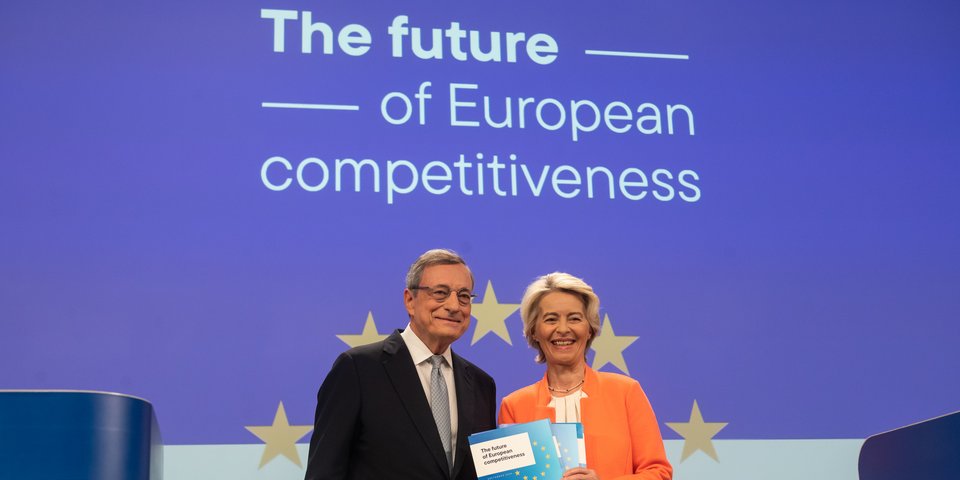
the occasion of the first anniversary of the publication of the Draghi
Report on the future of European competitiveness, a conference on the subject was held on 16 September. Former Italian Prime Minister and
former President of the European Central Bank (ECB), Mario Draghi, expressed
disappointment at the limited progress achieved so far, though he praised the
individual steps taken by the European Commission in the meantime. He
particularly criticised the pace of reform and the lack of willingness to
pursue it. The EU must deliver results in months, not years, and be prepared to
make radical changes. Competitiveness, the removal of barriers to investment
and the internal market as a key sales market for European products must be at
the top of the European agenda.
Common capital market
While
European Commission President Ursula von der Leyen pointed to the progress
made, Draghi criticised the continuing weakness of investment in Europe. Every
year, hundreds of billions of euros are lacking for digitalisation,
decarbonisation, defence and innovation. He particularly criticised the
continuing fragmentation of capital markets, which hampers the creation of
venture capital. He also pointed to political blockages against joint financing
instruments, as well as sluggish reforms in insolvency and tax law. He
warned that without decisive integration, clear financing and the removal of
national barriers, Europe risks falling permanently behind in global
competition.
Member States in focus
One
year after the publication of his report, Draghi criticised the slow
implementation and the unwillingness to tackle radical changes. As an example, he
referred to the process of introducing a uniform European company form. This
would allow businesses to grow and raise capital under the same rules across
all member states. Implementation is on the EU agenda. In her speech on the state of the Union, President von der Leyen announced that a roadmap for
the single market up to 2028 would be presented in the autumn. However,
according to Draghi, the lack of political will in many member states risks the
project’s failure. All that would remain then would be a digital
corporate identity.
Priority: European AI ecosystem
Draghi
also emphasised that Europe must act quickly and decisively and enable
economies of scale in order to be competitive in key technologies such as
artificial intelligence (AI). Barriers to investment must be removed. In
particular, he called for deep cuts to the EU General Data Protection
Regulation (GDPR) and for a pause in the implementation of parts of the AI Act
– especially the provisions for high-risk applications. This, he argued, would
provide European companies with access to data and legal certainty. Both are
necessary for AI technologies to be developed competitively in the EU. The
Commission is currently examining how the EU AI Act can be simplified. Draghi's
demands are likely to bring supporters of a ‘suspension’ of the AI Act in
industry and the Member States back into the picture.
Joint debt
Draghi
also returned to the issue of joint European debt. According to ECB estimates,
the annual investment required has risen from €800 billion to €1.2 trillion
since last year. Due to higher defence spending, the public share must also
grow more strongly. While joint debt instruments do not automatically expand
fiscal space, they do facilitate investment in large projects that are
necessary for the EU's competitiveness.
Still no focus on social investment
In
his speech, Draghi also mentioned in one sentence the importance of investing in
people for Europe's productivity growth and innovative strength. However, his
focus remained clearly on a single capital market and the promotion of
investment. His approach thus continues to differ significantly from that of
the Letta
Report, presented in April 2024. The latter emphasises the central role of
an effective social protection system and considers social investment to be
just as important as investment in research, development and infrastructure.