
 European Parliament
State of the Union address
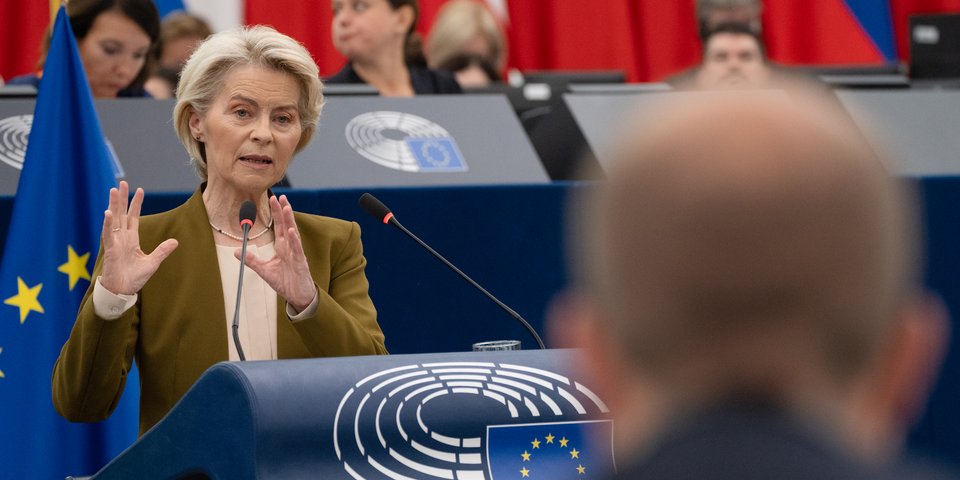
Speech by Commission President von der Leyen before the European Parliament.
JA – 09/2025
On 10 September, Commission President Ursula von der Leyen delivered her annual State of the Union (SOTEU) address before the European Parliament in Strasbourg. The focus was on foreign policy, particularly in light of Russia’s war of aggression against Ukraine and the current situation in the Gaza Strip. Another central theme was the competitiveness of the European Union (EU), while social and health policy played a less prominent role.
Competitiveness
A key priority of the address was the enhancement of the EU’s competitiveness. In this context, the European Commission will present a roadmap for the completion of the Single Market by 2028, von der Leyen announced. This will place particular emphasis on capital, services, energy, telecommunications, the so-called 28th regime, as well as knowledge and innovation. The introduction of a 28th regime would not only support innovative enterprises but also advance the Savings and Investment Union.
Social policy
In her State of the Union address, von der Leyen called for an ambitious European strategy to combat poverty. Core elements of this strategy include the European Child Guarantee and initiatives to reduce the cost of living. To address the housing crisis, EU state aid rules should be reformed and the construction of affordable housing facilitated. Furthermore, von der Leyen announced a Quality Jobs Act. Commissioner Roxana Mînzatu later specified that this legislative act would support fair wages and working conditions, ensure high standards of health and safety at work, and promote upskilling and just labour market transitions.
Health policy
According to von der Leyen, Europe must also assume leadership in global health policy. Global progress in eradicating diseases such as measles and polio is under threat, and another global health crisis is looming. Against this backdrop, she announced that the EU would take the lead in a new Global Health Resilience Initiative aimed at strengthening global health preparedness. For von der Leyen, Europe’s leading role in this endeavour is beyond question.
Europe’s digital future
Looking ahead, von der Leyen stressed the importance of massive investments in digital technologies and clean tech. Artificial intelligence (AI), in particular, plays a key role in ensuring the Union’s strategic autonomy. AI will significantly contribute to strengthening Europe in essential areas such as healthcare and defence. The EU is initially focusing on core frameworks – ranging from legislative acts on the development of cloud and AI technologies to quantum technology testbeds. Investments are vital to safeguarding Europe’s technological and political sovereignty.
EU’s capacity to act
Another central appeal concerned the EU’s capacity to act in times of crisis. The newly concluded interinstitutional framework agreement between the European Commission and the European Parliament will further strengthen cooperation between the two institutions, thus enabling necessary reforms. Von der Leyen expressed support for a right of initiative for the European Parliament and advocated a shift to qualified majority voting in the Council in certain areas, such as foreign policy. Moving away from unanimity is essential. The EU’s ability to respond swiftly and effectively to current challenges is decisive for its continued relevance and global standing.
Reaction of Members of Parliament
Von der Leyen’s address covered a broad spectrum of issues, reflecting the platform supported by the EPP, S&D, and Renew – albeit increasingly fragmented. Nevertheless, Members of the European Parliament reacted in very different ways. Manfred Weber (EPP, DE) directly criticised the S&D, arguing that their objections to the omnibus files and the customs compromise with the US were undermining the European agenda. Iratxe García Pérez (S&D, ES) countered that while von der Leyen sought to preserve the platform, Weber himself was the obstacle to cooperation. Valérie Hayer (Renew, FR) dismissed the spectacle as ludicrous and urged pro-European forces to maintain unity.