
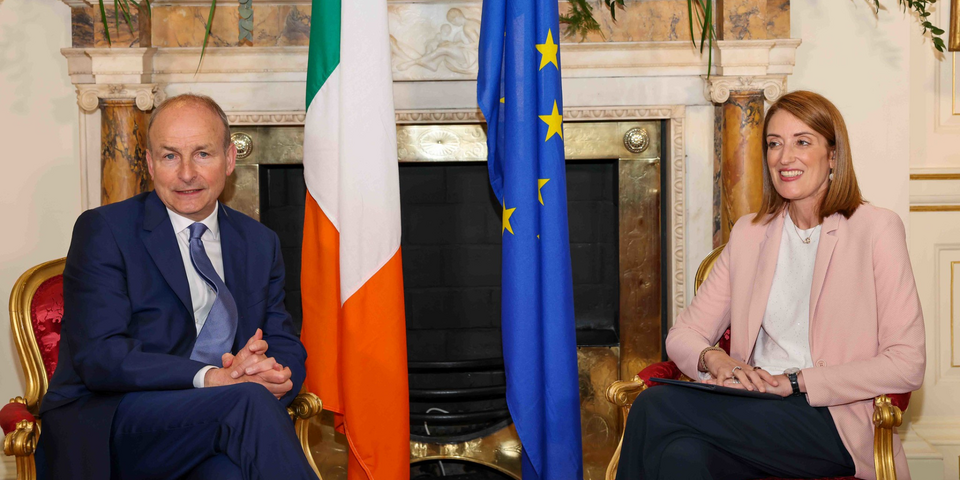
 © Ireland’s EU Presidency
Ireland’s Agenda for Europe
Irish Presidency of the Council aims to create opportunities and protect people.
AS – 06/2026
Under the motto “Strength
through Unity” (“Ní neart go cur le chéile”), Ireland will assume the
Presidency of the Council of the European Union (EU) in the second half of
2026, succeeding Cyprus. It will be Ireland’s first
Presidency since Irish became one of the official working languages of the
European Union in January 2022. Through its Presidency, Ireland intends to
underline the Union’s commitment to linguistic diversity and integrate the Irish
language into the work of the Council, official communication and cultural
events.
Strengthening Europe’s capacity to act: Priorities of the Irish Council Presidency
At a time of economic
transformation and geopolitical uncertainty, the Irish Presidency presents
itself in its programme as a consensus-oriented and moderating force. The Council is to be
strengthened as a forum for joint decision-making and Europe’s strategic
resilience. Accordingly, the focus is less on launching new initiatives and
more on advancing viable compromises and delivering tangible progress on
existing legislative files. Ireland’s objective is to
strengthen Europe’s capacity to act in times of global uncertainty through
implementation, reliability and unity.
This also includes
supporting common security efforts, such as enhancing the EU’s foreign policy
capacity, strengthening cooperation in addressing hybrid threats and
reinforcing critical infrastructure. Existing international partnerships are
likewise to be deepened. Through its Presidency,
Ireland also aims to advance the resilience of European value chains and
further develop the Capital Markets Union in order to secure the EU’s long-term
economic competitiveness. Reducing regulatory barriers and improving the business
environment are intended to go hand in hand with the digital and green
transitions.
Within the framework of the
Employment, Social Policy, Health and Consumer Affairs Council (EPSCO), the
Presidency seeks to strengthen quality of life and living standards across
Europe, promote equal rights and social inclusion, and combine sustainable growth
with competitiveness.
Ireland explicitly presents
European social and health policy as part of a shared European social and
economic model based on resilience, cohesion and equality.
Employment and a modern labour market
Employment policy will
focus on how to create and secure high-quality jobs in a changing European
labour market. The Irish Presidency
intends to advance discussions on how employees and employers can succeed both
within and beyond the Single Market. It also aims to promote safer, healthier
and more productive workplaces.
As part of the FairLabour Mobility Package, which is expected to be published during the
Irish Presidency, Ireland intends to prioritise two initiatives:
- The
development of the European Social Security Pass (ESSPASS),
designed to make it easier for citizens to prove and exercise their social
security entitlements when living or working in another EU Member State;
- Strengthening
the mandate of the European Labour Authority (ELA) to improve
the implementation and enforcement of fair working conditions across the EU.
These initiatives aim to
reinforce the EU’s social safety net, strengthen the protection of workers’
rights and promote high employment standards across all Member States.
Social policy, equality and inclusion
Another priority is the
further development of the European equality and social model.The Irish Presidency
emphasises that equal rights, non-discrimination and social participation are
key prerequisites for economic development and democratic stability.
Within the framework of the
new European Gender Equality Strategy 2026–2030, particular
attention will be paid to the care economy, the impact of technological change
on labour markets and participation in political and economic decision-making
processes.
The Presidency underlines
that social investment not only helps combat poverty and exclusion but can also
foster innovation, skills development and economic growth.
Health as a prerequisite for competitiveness
In health policy, Ireland
highlights the connection between strong health systems, innovation and
economic performance. Access to high-quality
healthcare is understood both as an expression of European values and as a
prerequisite for social and economic resilience.
The priorities of the Irish
Presidency therefore include advancing key health files, in particular
negotiations on the EU Biotech Act as well as revisions to the Medical Devices Regulation (MDR) and the In Vitro
Diagnostic Medical Devices Regulation (IVDR). A particular focus will be
placed on women’s health. Ireland explicitly refers
to previously underserved health areas – including conditions such as
endometriosis – and highlights their impact on labour market participation,
healthcare outcomes and social equality.
Through this approach, the
Presidency aims to anchor health policy more firmly as an integral component of
a future-oriented European economic and social agenda.
A Social Europe as a competitive advantage
Overall, Ireland links its
EPSCO priorities to the idea that European values – including equality, the
rule of law, solidarity and non-discrimination – are not only guiding societal
principles but also a source of economic competitiveness. The Presidency therefore
sees social investment, high-quality employment and resilient health systems as
essential conditions for strengthening Europe’s attractiveness as a place to
live and work in the long term.