

 kobkeroku/stock.adobe.com
Simplification as a guiding political principle
ed* No. 01/2026 – Chapter 1
The European Commission aims to launch a “fleet of omnibuses” to simplify European Union (EU) legislation across a wide range of areas – a formulation repeatedly used by European Commission President Ursula von der Leyen. The Commission has since followed up these statements with concrete action: in 2025 alone, it presented a total of ten such Omnibus proposals, with more expected to follow. They cover a wide range of policy areas, from sustainability and digitalisation to artificial intelligence (AI), as well as agriculture, defence and chemicals.
These initiatives are part of a broader agenda to reduce administrative burdens, aiming to cut recurring administrative costs by 11.9 billion euros annually and provide tangible relief for businesses. At its core, the objective is to make existing rules easier to apply. One example concerns sustainability reporting requirements, which many companies perceive as particularly complex and resource intensive. The simplification agenda seeks to make these rules more practical while at the same time strengthening the competitiveness and resilience of the European economy.
The so-called Omnibus packages are only one element of this broader approach. In parallel, the European Commission continues to revise individual pieces of legislation – often guided by the same principle of simplification. Examples include targeted amendments to the Medical Devices Regulation (MDR) and the In Vitro Diagnostic Medical Devices Regulation (IVDR), as well as the planned revision of the REACH Regulation in the field of chemicals legislation.
However, these initiatives are not directly comparable. While all simplification proposals pursue a similar overarching objective, they differ significantly in their political background, legal approach and scope of amendments. At EU level, an “Omnibus” refers to a legislative procedure through which several existing EU legal acts are amended simultaneously. Such packages bundle thematically related provisions and adapt or partially repeal them collectively. The currently discussed amendments to the MDR and IVDR are not as far-reaching. They therefore do not qualify as Omnibus packages but rather as targeted adjustments to individual legal acts, primarily aimed at addressing concrete implementation challenges and making existing systems more workable in practice.
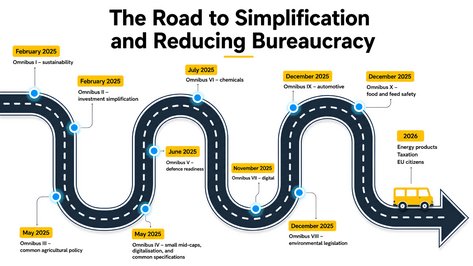
Whether additional Omnibus packages will follow beyond those already proposed and announced remains to be seen. The Commission, however, intends to continue along this path. The goal is to reduce administrative burdens for businesses by at least 25 per cent and by as much as 35 per cent for small and medium-sized enterprises (SMEs) through Omnibus packages and further simplification measures. Accordingly, in mid-February, Ursula von der Leyen emphasised to EU Heads of State or Government that the reduction of bureaucracy in the EU is far from complete.
In particular, packages addressing sustainability, digitalisation, internal market rules and chemicals legislation contain important implications for social security systems.
Although many of the proposals to date may at first glance appear to have little direct relevance for social security, a closer look reveals numerous points of interaction. In particular, packages addressing sustainability, digitalisation, internal market rules and chemicals legislation contain important implications for social security systems.