

 iStockphoto/4X-image
Less bureaucracy in medical devices and in vitro diagnostics – with risks?
ed* No. 01/2026 – Chapter 3
Simplification is also being discussed in the health sector. While there is formally no dedicated Health Omnibus, a new proposed Regulation of 16 December 2025 amending the Medical Devices Regulation (MDR) and the In Vitro Diagnostic Medical Devices Regulation (IVDR) clearly follows the political guiding principle of simplification. Terms such as burden reduction, simplification, reduction of bureaucracy or cutting red tape have since shaped the debate.
This concerns a regulatory framework of great practical importance. The MDR has been in force since 2017. It was fundamentally revised following serious quality scandals, most notably the French breast implant scandal involving PIP. The aim was to ensure high safety and quality standards for medical devices. Medical devices and in vitro diagnostics cover a wide spectrum: from simple products such as contact lenses and surgical masks to blood tests and pacemakers, as well as implants and complex equipment such as MRI scanners. Before such products may be used in the EU, they must undergo clinical evaluation and certification.
Background on the MDR
Regulation (EU) 2017/745 on medical devices (MDR) and Regulation (EU) 2017/746 on in vitro diagnostic medical devices (IVDR) form the central European legal framework for the quality, safety and performance of medical devices and in vitro diagnostics. Their objective is to improve the safety of products placed on the market, to strengthen the requirements for clinical evaluation – particularly for high-risk products – to increase transparency through the European database EUDAMED, and to harmonise the quality and oversight of Notified Bodies across Europe. Unlike medicinal products, medical devices in the EU are not authorised by public authorities but are certified by Notified Bodies. The 2017 Regulations significantly tightened these certification requirements. As a result, many existing products must be re-evaluated and re-certified, while stricter requirements apply to new products. The MDR has applied since 26 May 2021, and the IVDR since 26 May 2022. In order to give Notified Bodies and manufacturers time to adapt, transitional periods were introduced.
This is precisely why the Regulation is now once again in focus – under the banner of reducing bureaucracy. In the political debate, there is talk of bottlenecks, costly mistakes and unnecessary bureaucracy. Manufacturers complain about lengthy certification procedures, certification bodies – the so-called Notified Bodies – about complex requirements, and Member States are concerned about the availability of certain products on the market. This can have very concrete consequences, not only for hospitals or medical practitioners that may have to wait longer for essential products or switch to alternatives but also for the provision of healthcare to insured persons.
With the current proposal for amendment, the European Commission aims to address these issues: faster certification procedures, reduced administrative burdens for manufacturers and greater predictability for Notified Bodies are intended to help ensure that the production and certification of medical devices in Europe remains attractive and that the availability of medical devices is secured. Among the measures envisaged are new classification rules, adjustments to certification requirements and specific provisions for certain product groups (such as orphan devices, breakthrough devices or well-established technologies). Simplifications are also foreseen for new technologies such as AI-based medical devices. In addition, increased digitalisation of regulatory processes is intended to help accelerate procedures.
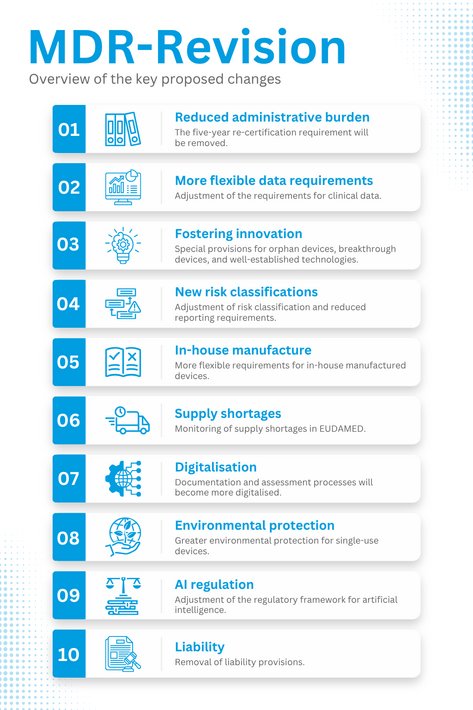
Some of these proposals are sensible. Avoiding duplicate reporting, digitalising documentation requirements or improving coordination between authorities can indeed reduce bureaucracy and make the day-to-day work of Notified Bodies and manufacturers noticeably easier without lowering the level of protection or the safety of medical devices for insured persons. This is where genuine potential for relief lies.
However, other elements that go beyond procedural simplification and weaken safety and quality requirements raise fundamental questions. This concerns, for example, the planned flexibilisation of requirements for clinical data, i.e. the question of which and how many clinical data a product must demonstrate. Changes to risk classification as well as general simplifications for certain product groups must also be critically examined. These adjustments do not only concern procedures but rather the substantive core of the MDR and IVDR. Ultimately, the issue is how thoroughly a product is tested and what level of evidence must be available before it is used for patients or in the daily work of medical professionals. This is crucial in practice. Doctors, nurses and laboratory staff must be able to rely on the safe functioning of the products they use.
Simplification must therefore not be confused with deregulation. Safety and evidence requirements are not unnecessary bureaucracy but essential protective instruments for patients and healthcare professionals. A general lowering of quality standards could shift risks – away from manufacturers and assessment bodies such as Notified Bodies, and towards patients.
It is striking that the Commission is using the current debate on reducing bureaucracy to reopen more fundamental questions. These include, for example, additional tasks for the European Medicines Agency (EMA), stricter environmental requirements for single-use products or more reporting obligations for supply shortages via EUDAMED. This shows that the discussion is not only about making rules simpler; in part, it is also about how markets are organised and how Europe can be strengthened as an economic location.
A similar development can be observed in the pharmaceutical sector. On the one hand, there is a focus on preventing supply shortages, for example through the Critical Medicines Act. On the other hand, there is also an aim to expand production in Europe and strengthen competitiveness vis-à-vis the United States and China. “Made in Europe” is to be promoted. These are legitimate objectives. However, they should be addressed through dedicated industrial policy measures – and not within legislation that primarily concerns the safety, approval and certification of products, such as the MDR.
In the end, one central question remains: where does simplification genuinely help, and where does a gradual lowering of standards begin? Less bureaucracy can be meaningful – but only where procedures are streamlined without lowering the level of protection. What is crucial is that gains in efficiency do not come at the expense of patient safety, the quality of evidence and the financial sustainability of healthcare systems.