Annual Review
Merry Christmas and a Happy New Year 2026!
DSV – 12/2025
Dear readers,
Where has the year gone? A question many people ask themselves as the year draws to a close – and we are no exception. Looking back, we can see which topics were particularly in focus for us as the European Representation of the German Social Insurance this year, which goals we achieved, and where our time was truly spent.
Following the new Commission’s assumption of office on 1 December 2024, 2025 marks the first year after the European elections under conditions of political normality. With the start of the Polish Presidency of the Council in January 2025, a new trio presidency began, in which - together with Denmark - the focus was placed on security and competitiveness. These priorities were also reflected in the work of the European Commission, which launched a series of so-called omnibus initiatives aimed at simplifying the EU regulatory framework across numerous policy areas.
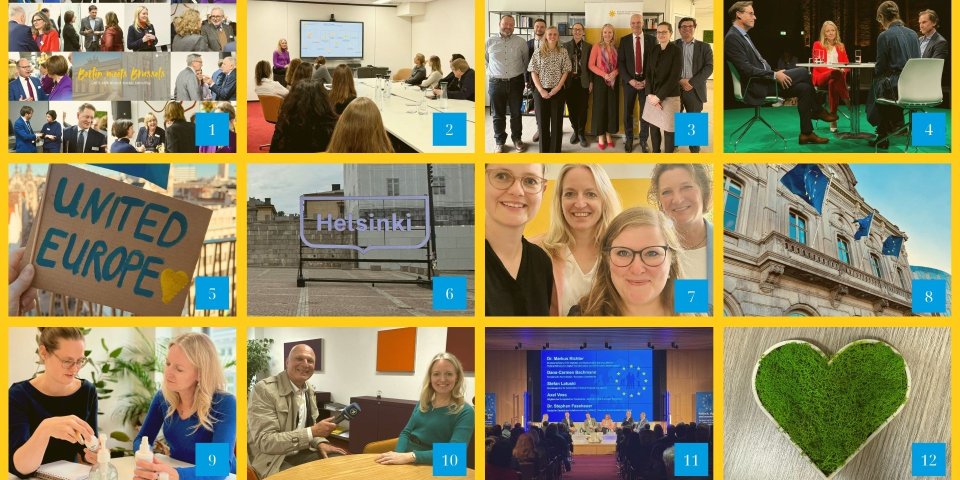
January therefore, proved to be an opportune moment for us to deliberately set priorities with a parliamentary evening and to engage in dialogue at the start of the new legislative term. The aim was to enter into discussions on current and relevant initiatives together with Members of the European Parliament, senior representatives of the European Commission and the Member States, as well as our Executive Board from Berlin. The discussions focused, among other things, on social investment, the coordination of social security, digitalisation, and health and safety at work policy - including issues such as access to medicines, prevention, and the use of new technologies. The evening provided space for an open and trusting exchange on how social security, health, and economic strength in Europe must be jointly conceived and shaped. We look forward to continuing this format in 2026.
An initial look at the European Commission’s 2025 Work Programme raised some doubts, as social policy initiatives featured only to a limited extent. This also prompted us to question what role social policy would play in the future alongside economic and defence policy. On closer inspection, however, it became clear that this was less a loss of importance than a shift in the narrative. Key initiatives for social insurance - for example, in the areas of labour protection, chemicals policy and health and safety - were increasingly framed in the context of economic and security policy. This applies, for instance, to the Critical Medicines Act as well as to the planned revision of the REACH Regulation, which governs the registration, evaluation, authorisation and restriction of chemicals in the EU. For us as a representative body, this meant following initiatives more closely across perceived departmental boundaries and highlighting social concerns in an even more proactive manner. This approach also led to new contacts established over the course of the year, enriching dialogue on social issues beyond traditional lines of responsibility.
This new narrative is also evident in the country reports of the European Semester. For Germany, insufficient public investment is identified as a key challenge. Accordingly, last year’s recommendations criticised the level of federal subsidies. In order to increase fiscal space for future-oriented public investment, a reduction in federal subsidies is recommended. In addition, the absence of a funded pillar in the pension system has a negative impact on private investment in equities, companies’ access to finance, as well as on growth and innovation. For us, this means working even more closely with European partners to underline the importance of social investment. In a joint project with colleagues from DRV Bund, we succeeded in demonstrating the effectiveness of medical rehabilitation interventions with a positive macroeconomic impact. Initial discussions have already taken place on feeding this work into the Social Investment Knowledge Hub established by the European Commission in mid-September.
One cross-cutting issue that particularly occupied us this year was digitalisation. Against this backdrop, in November, we jointly organised a conference on digitalisation in the public sector together with the German Social Accident Insurance (DGUV), the German Pension Insurance Fund (DRV Bund) and the National Association of Statutory Health Insurance Funds (GKV-Spitzenverband). The aim was to demonstrate that social insurance also contributes to Europe’s competitiveness - not least through advancing digitalisation and the use of artificial intelligence (AI). Under the title “EU Transformation Talks”, the focus was on dialogue between European and national policymakers, public administrations and social insurance institutions. Representatives of the EU institutions, German ministries and social insurance bodies from across Europe discussed how digital innovations can contribute to more efficient administrative processes, improved services and stronger European cooperation - and which legal, organisational and societal conditions are required to make this possible. The event once again made it clear to us that Europe does not begin in Brussels alone, but wherever national actors engage at an early stage and assume responsibility.
However, the central focus of our day-to-day work remained European social and health policy. Accordingly, we once again engaged with great commitment in a wide range of legislative initiatives this year. We drafted statements, set out our views in policy papers, and exchanged perspectives with experts as well as with political decision-makers. Among the most important legislative processes that occupied us in 2025 were the EU pharmaceutical reform, the Critical Medicines Act, the health package, the reform of chemicals assessment under the principle of “one substance, one assessment”, the revision of the EU Standardisation Regulation, and the revision of insolvency law. Many of these files could be brought to a positive outcome; others, however, will continue to accompany us into 2026.
As we prepare to embark on the new year, we would like to extend our sincere thanks to you - to all our readers - for the pleasant and constructive cooperation. The exchange here in Brussels and beyond is a great gift to us, and we very much look forward to continuing to work together in 2026 for a social, democratic and diverse Europe.
We wish you a restful and enjoyable winter season as well as a peaceful Christmas. May you spend relaxing days with your loved ones and enter the new year in good health.
Yours sincerely,
The DSV Team