

 Getty Images - AndreyPopov
A new framework for the EU budget
ed* No. 02/2026 – Chapter 2
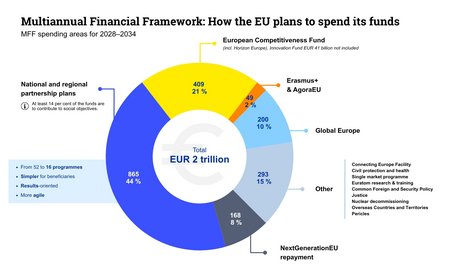
The European Commission’s proposal for the MFF focuses on three major areas of expenditure: 865 billion euros is earmarked for investment and reforms under the National and Regional Partnership Plans. A new European Competitiveness Fund, including the Horizon Europe research programme, is to receive 409 billion euros. A further 200 billion euros is earmarked for strengthening Europe’s role in the world.
Overall, the European Commission’s proposal for the period 2028–2034 amounts to just under two trillion euros, equivalent to an average of 1.26 per cent of the EU’s gross national income (GNI).
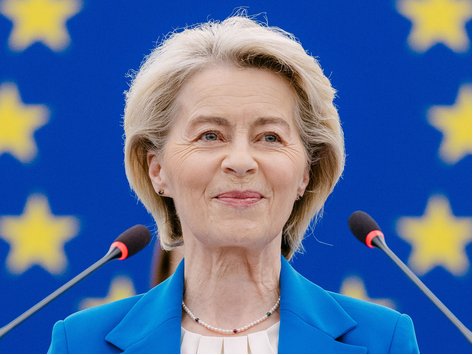
Our new long-term budget will help protect European citizens, strengthen Europe’s social model and make our European industry thrive.
Source: European Commission; https://ec.europa.eu/commission/presscorner/detail/en/ip_25_1847
At the same time, the European Commission aims to simplify the currently highly fragmented funding landscape and reduce the administrative burden. To achieve this, numerous programmes are to be consolidated and the different funding rules further harmonised. A key innovation is the National and Regional Partnership Plans: within these plans, previously separate funding instruments are to be brought together – including key instruments of cohesion policy, the Common Agricultural Policy (CAP) and the European Social Fund Plus (ESF+).
This change is particularly relevant from a social policy perspective. Under the European Commission’s proposal, at least 14 per cent of the resources available under the National and Regional Partnership Plans are to be allocated to social objectives. The European Commission puts this share at around 100 billion euros. While this is broadly similar in scale to the funding currently available under the ESF+, the resources would no longer be bundled in a stand-alone fund, but would instead form part of the broader Partnership Plans.
Source: European Commission; https://op.europa.eu/en/publication-detail/-/publication/10993d4a-d7d1-11f0-8da2-01aa75ed71a1/language-en
Through the Partnership Plans, the European Commission also aims to give Member States greater flexibility in the use of EU funds. Within their plans, Member States are to be able to decide which reforms and investments they wish to prioritise in order to address their national and regional challenges. Funding used at regional and local level is also to be incorporated into the Partnership Plans in the future. Under the Commission’s proposal, regions and municipalities are to be involved in the design and implementation of the plans.
However, the greater flexibility in the use of funds is accompanied by a stronger focus on results. The reforms and investments set out in the Partnership Plans are to be linked to specific milestones and targets. Milestones could include, for example, the adoption of legislation or the establishment of a particular structure. Targets, by contrast, describe measurable results, such as a specified number of people reached or measures implemented.

I am critical of the Commission’s proposal to link funding to milestones in future, rather than reimbursing specific costs. Such a system would make parliamentary budgetary scrutiny considerably more difficult. In addition, the country-specific recommendations on which these milestones are to be based are developed through a process that lacks transparency and has only weak democratic legitimacy. For me, it is therefore clear that EU funding must continue to be closely linked to specific investments and costs actually incurred. Only in this way can we provide planning certainty and ensure that European funds are used in a transparent and targeted manner.
The new MFF is therefore intended to go beyond financing individual policy areas and programmes and to be used more strategically as an instrument for implementing the EU’s political priorities.
Jonathan Zeitlin, Distinguished Faculty Professor of Public Policy and Governance Emeritus at the University of Amsterdam, considers the proposed model to represent the most far-reaching change to EU budgetary governance since the introduction of the Structural Funds in the 1980s. He sees particular advantages in more coherent and better integrated funding instruments, closer alignment between EU and Member State objectives, and a stronger performance orientation of the EU budget. At the same time, he warns of the risks of excessive centralisationand standardised common indicators that may not be sufficiently sensitive to differing national and regional contexts.