

 pixabay-krea2pc
Who determines the direction of reform?
ed* No. 02/2026 – Chapter 4
The European Semester is intended to play an important role in shaping the Partnership Plans. The challenges identified under the European Semester are to be taken into account in the future when defining reforms and investments in the National and Regional Partnership Plans.
This could also change the practical significance of the country-specific recommendations. At present, they are not legally binding. A Member State is therefore not required to implement a particular reform solely on the basis of such a recommendation. However, if a corresponding reform objective is incorporated into a Partnership Plan and linked there to milestones, targets and payments, it acquires additional weight: while the country-specific recommendation itself remains non-binding, implementation of the agreed reform steps may become a condition for the disbursement of EU funds.
For this reason, governance scholar Jonathan Zeitlin also considers that the voting rules under which the country-specific recommendations are adopted should be reviewed. If the recommendations acquire greater budgetary significance in future, he argues that the voting rules should ensure that reform priorities reflect a broad consensus among the Member States rather than the European Commission’s own institutional views.

Should the Commission’s proposals for the next MFF be adopted, it will have a key role in assessing how Member States’ draft plans address the reform challenges identified in the CSRs, though the final decision on their approval will be taken by the Council.
Drawing on the experience of the Recovery and Resilience Facility, Zeitlin emphasises the responsibility of national governments when drawing up the plans. They should formulate their reform proposals carefully and ensure inclusive input from social partners and other societal stakeholders – not least because the disbursement of EU funds may depend on fulfilment of the agreed commitments.
The European Commission would also play an important role in implementation: it is to assess whether the milestones and targets agreed in the plans have been achieved and, therefore, whether the conditions for the disbursement of the corresponding EU funds have been met. In this way, it would monitor the implementation of the agreed national reforms over the lifetime of the Partnership Plans and assess their progress.
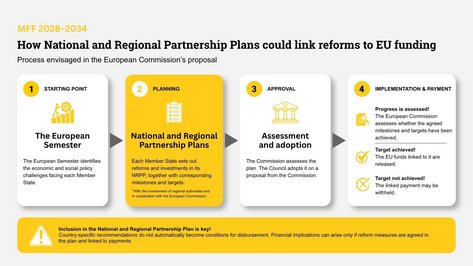
The specific design of the reforms remains the sole responsibility of the Member States. At the same time, linking reform objectives to EU funding could increase EU-level influence over national reform processes. Beyond its financing function, the EU budget could thus increasingly become an instrument of policy governance.
What is the European Semester?
Under the European Semester, the EU coordinates the Member States’ economic, employment and social policies each year. The European Commission analyses economic and social developments in the individual Member States and puts forward proposals for country-specific recommendations (CSRs). These identify policy challenges and potential reform needs. The recommendations are adopted by the Member States and are not legally binding.